

Local SEO helps nearby customers discover and choose your business when they search for a service in their area. It connects your website, Google Business Profile, reviews and wider online reputation into one consistent local presence.
- Complete and maintain your Google Business Profile
- Create useful location and service content
- Build consistent citations, relevant links and genuine reviews
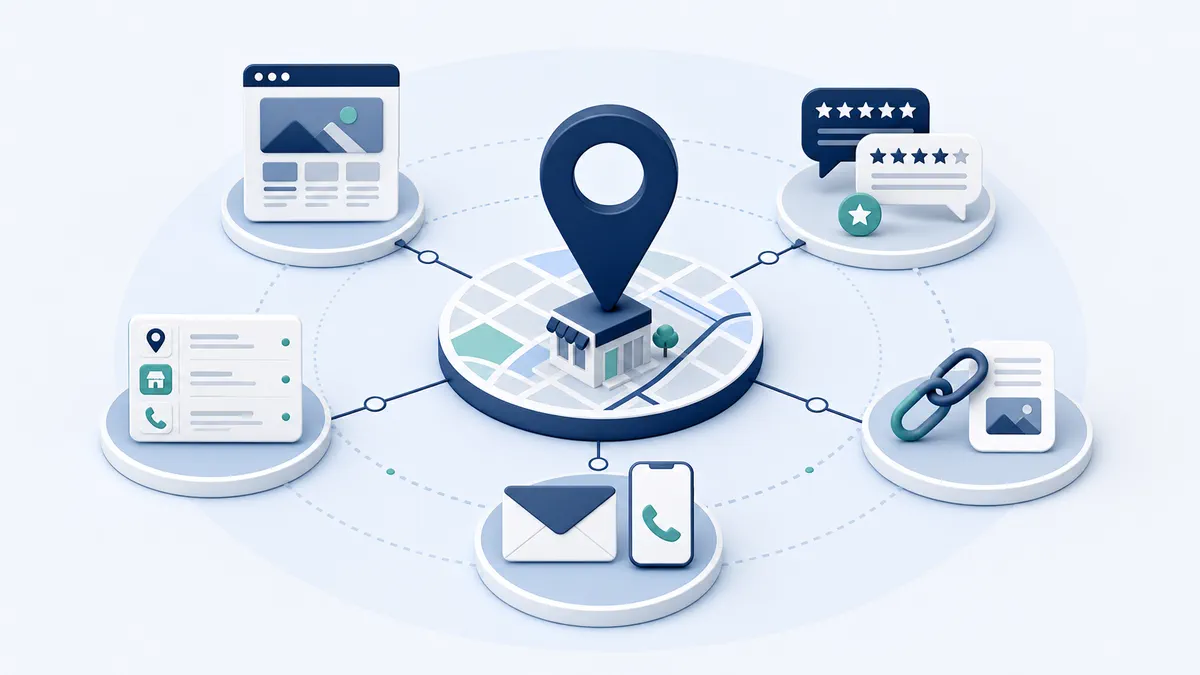
How local search visibility works
Google explains that local results are mainly influenced by relevance, distance and prominence. Distance depends on the searcher, but businesses can improve relevance and prominence by providing accurate information, earning genuine reviews and building a credible presence across the web.
Local SEO is not a switch that guarantees a top position. It is the ongoing work of making your business easier to understand, verify and trust.
Complete your Google Business Profile
Choose the most accurate primary category, add appropriate secondary categories, use a consistent business name and keep contact details and opening hours current. Add services, service areas, a clear business description and high-quality real photographs.
A complete profile gives Google more context and gives customers fewer reasons to leave and look elsewhere. Review it whenever hours, services, telephone numbers or locations change.
Build service pages that match local intent
A profile is stronger when it connects to a useful website. Create a focused page for each priority service and explain who it helps, what is included, how the process works and what the next step is. Include location information naturally where it is genuinely relevant.
Avoid producing dozens of near-identical town pages with only the place name changed. Useful local pages need distinct evidence: projects, travel coverage, local knowledge, testimonials, photographs or specific service details.
Keep your business details consistent
Your name, address and telephone number should be consistent across your website, Business Profile and reputable directories. Correct major inconsistencies and prioritise relevant industry or local listings over bulk submissions to low-quality directories.
On your website, place core contact information where visitors can find it and add appropriate organisation or local business structured data when it accurately represents the business.
Earn and respond to genuine reviews
Ask customers for an honest review after a completed project or successful service interaction. Make the process simple with a direct review link, but never offer incentives for positive sentiment or write reviews on a customer’s behalf.
Respond professionally to both positive and negative reviews. Useful replies show that the business is active, accountable and attentive. They also help prospective customers understand how you communicate.
Build local authority
Relevant links and mentions can strengthen prominence. Look for genuine opportunities through local partnerships, chambers of commerce, suppliers, community initiatives, sponsorships, professional bodies and useful expert contributions. One credible local mention is worth more than a large batch of unrelated links.
Publish content that answers local questions
Create articles and guides from real customer conversations: pricing considerations, service-area questions, preparation checklists, local regulations or comparisons that help someone make a decision. Keep content people-first and connect it to the most relevant service page.
Measure enquiries, not only rankings
Track calls, forms, bookings, direction requests and qualified leads. Review Business Profile performance, Search Console queries and analytics landing pages together. Rankings can vary by location, device and search history, so commercial outcomes provide a more reliable view.
- Check profile completeness and accuracy monthly.
- Request reviews consistently after real customer interactions.
- Review local landing-page conversions.
- Monitor duplicate listings and incorrect contact details.
- Record which sources produce qualified enquiries.
Frequently asked questions
How long does local SEO take?
Some profile updates can appear quickly, while meaningful improvement in visibility and enquiries usually develops over months. Competition, location, existing authority and review activity all affect the pace.
Do local businesses still need a website?
Yes. Your website gives you control over service detail, proof, conversion journeys and measurement. It also supports the relevance and credibility of your wider local presence.
Turn local search intent into useful pages
Local searches often combine a service, a place and an immediate need. Build pages that resolve that need rather than repeating a location name. Explain coverage, availability, process, typical questions and the evidence that proves you serve the area. Include directions or practical location context when customers visit you, and clear service-area information when you travel to them.
Research language through Search Console, Business Profile interactions, sales conversations and site search. Group similar questions into one comprehensive page instead of creating thin pages for every keyword variation. Use descriptive titles and headings naturally; forced repetition makes content harder to trust.
Optimise the website for local confidence
Place consistent contact details on the contact page and relevant site areas. Provide a real address only when customers can visit or it accurately represents the business. Add opening hours, accessibility information, parking, service radius and emergency arrangements where relevant. Embed a map when it helps visitors, but do not let it slow every page.
Show local proof: projects, photographs, team involvement, partnerships and testimonials from genuine customers. Connect each proof item to a service. A visitor looking for a specialist nearby needs evidence of both competence and availability.
Build a sustainable review process
Choose natural moments to request feedback: after delivery, a successful appointment or resolution. Send a short personal request with a direct link. Do not filter requests so only happy customers receive them, and do not use staff or suppliers to manufacture sentiment. A steady pattern of genuine reviews is more credible than a sudden burst.
Create a response standard. Thank positive reviewers without repeating private details. For criticism, acknowledge the experience, explain the next step and move sensitive discussion offline. Reviews are public customer service, not a debate to win.
Improve prominence through real relationships
Local authority comes from being part of a place or sector. Useful opportunities include professional memberships, local suppliers, educational partnerships, community projects, events, expert commentary and sponsorships that genuinely fit the business. Ask partners to link to the most relevant page and provide accurate information they can use.
Avoid paying for large packages of directory links. Audit existing citations first, correct important listings and remove duplicates where possible. Focus on sources customers or search engines could reasonably trust.
Use photographs that verify the business
Upload current, well-lit photographs of the premises, team, work, products and customer environment where permission exists. Use consistent quality without making everything look artificial. Update seasonal or outdated images, and select a strong cover image that remains recognisable at small sizes.
Optimise website images with descriptive file names and meaningful alternative text when the image conveys information. Do not stuff city names into every alt attribute. Describe what is visible and why it matters.
Track local SEO with a simple dashboard
Combine Business Profile calls, website clicks and direction requests with analytics conversions and Search Console data. Track qualified enquiries by source when possible. Record review volume and response time, important citation corrections and links earned. Use a small number of decision-ready measures rather than a report full of rankings.
Compare performance by service and landing page. If impressions increase but enquiries do not, examine offer clarity, proof and conversion friction. If profile views are strong but actions are weak, improve completeness, imagery and calls to action.
A 90-day local SEO plan
In the first month, verify ownership, correct business information, define conversions and improve the main service and contact pages. In month two, build review requests, publish one genuinely useful local resource and correct priority citations. In month three, pursue relevant local mentions, analyse enquiries and improve pages with high visibility but weak engagement.
Repeat the cycle quarterly. Refresh photographs, services and hours; respond to reviews; expand proven content and remove inaccuracies. Consistency is a competitive advantage because many profiles are abandoned after initial setup.
Local SEO questions businesses ask
Do keywords in the business name help?
Use the real-world business name. Adding keywords that are not part of the business name can violate platform guidelines and weaken trust.
Should every town have a landing page?
Only when you can provide distinct, useful information and genuinely serve that location. Near-duplicate doorway pages create a poor experience.
Are reviews more important than links?
They serve different roles. Reviews influence trust and local prominence; relevant links support authority. A balanced strategy earns both honestly.
Can a service-area business rank locally?
Yes, but it still needs accurate profile settings, a credible website, clear coverage and evidence of real activity in the areas served.
Local content ideas that demonstrate expertise
Publish resources that help a customer make a local decision: service preparation guides, realistic pricing factors, seasonal considerations, area-specific logistics, project walkthroughs and explanations of local processes. Use first-hand photographs and examples where permission exists. Interview the people who deliver the service so the article contains knowledge competitors cannot reproduce by summarising search results.
Connect every article to a relevant service page and a sensible next action. Update content when rules, prices or availability change. Avoid changing publication dates without meaningful improvement. Helpful local content earns visibility because it solves a problem, not because it repeats a city name.
Diagnose common local visibility problems
If the profile does not appear for branded searches, check verification, suspension notices, duplicates, naming and eligibility. If it appears for the name but not services, improve categories, service detail and website relevance. If visibility is reasonable but enquiries are weak, inspect photographs, reviews, offer clarity, landing-page speed and contact friction.
If one location performs and another does not, compare competition, distance, profile completeness, local proof, reviews and links rather than copying settings blindly. Document changes and allow enough time to assess them. Frequent uncontrolled edits make diagnosis difficult.
Coordinate local SEO with offline operations
Marketing cannot compensate for unanswered calls, incorrect hours or inconsistent service. Route profile messages and enquiries to an accountable person. Create processes for holiday hours, new services, location moves and closures. Train customer-facing teams to recognise review opportunities and escalate recurring complaints.
Use review themes as operational insight. Praise reveals what customers value; repeated criticism identifies friction the website or service may need to address. Share findings with management rather than treating reviews as an isolated marketing channel.
Questions to ask a local SEO provider
Ask how success will be measured, which work will happen on the website and profile, how reviews are handled and what access the provider needs. Reject guarantees of a number-one position or secret relationships with Google. Confirm ownership of profiles, analytics and created content. Reporting should connect actions to enquiries and explain uncertainty rather than hiding behind ranking grids.
A credible provider will discuss technical quality, content, reputation and conversion together. They should be willing to prioritise a smaller number of meaningful actions rather than sell hundreds of listings or automated pages.
Local SEO quality checklist
Before expanding activity, verify that the business category, name, telephone number, website, hours and location settings are correct. Confirm that the linked landing page loads quickly, explains the service and offers a clear contact route. Search for duplicates and old telephone numbers. Review photographs, unanswered reviews and questions. Check that local structured data agrees with visible website information and does not describe services or locations that are not genuine.
Then assess credibility from a customer’s perspective. Are recent reviews representative? Does the website show real work, people or premises? Can a visitor understand coverage, availability and the next step? Local SEO succeeds when search visibility and operational trust reinforce one another.
What should be avoided?
Avoid fake addresses, review gating, purchased reviews, keyword-stuffed names, mass-produced town pages and low-quality link packages. These shortcuts create platform, reputation and conversion risk. Build an accurate presence that remains useful even when ranking systems change.
Final tip: Keep a dated change log for profile edits, new reviews, directory corrections, local links and landing-page updates. When enquiries rise or fall, this record helps the team distinguish a meaningful improvement from seasonality, advertising, platform changes or temporary demand. Reliable local SEO is measured through evidence and sustained customer value.