

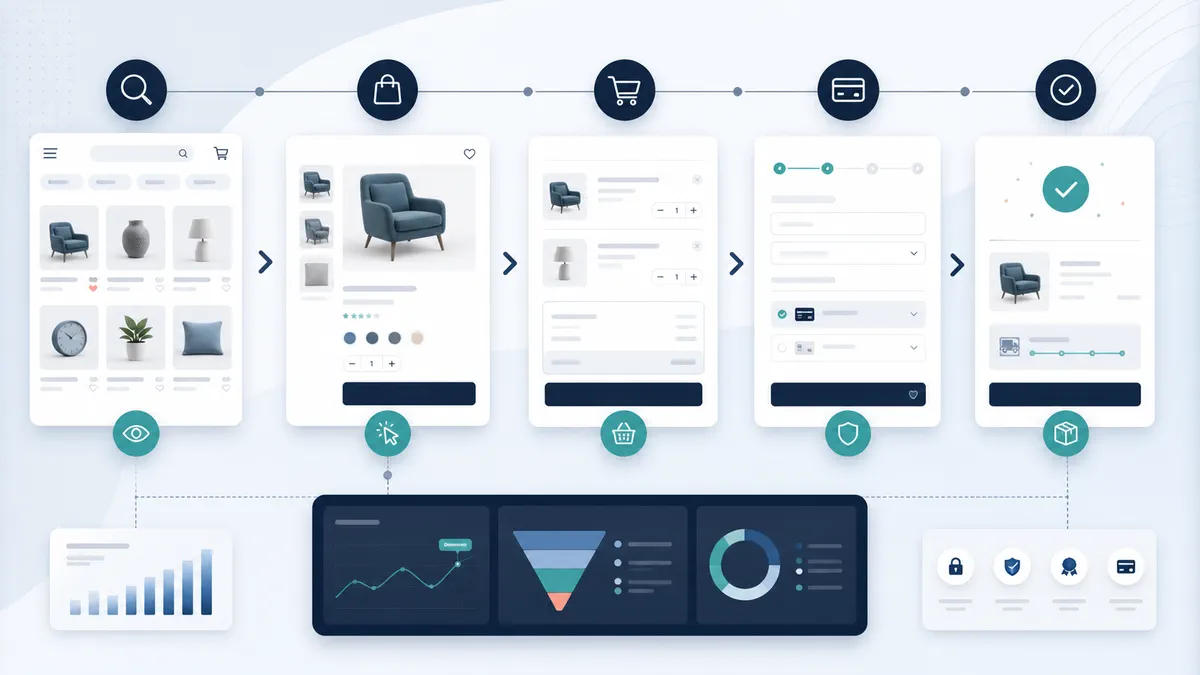
More traffic does not automatically create more revenue. E-commerce conversion optimisation improves the experience between landing and purchase so a greater share of existing visitors can find the right product, trust the offer and complete checkout.
- Product discovery and confident decision-making
- A low-friction mobile checkout
- Trust, speed and meaningful measurement
1. Make the value proposition immediate
Use the homepage and landing pages to explain what you sell, who it is for and why it is worth choosing. Avoid making visitors decode a clever headline before they understand the offer.
2. Simplify navigation
Organise categories around the way customers shop. Keep labels familiar, provide breadcrumbs and make important collections easy to reach. Deep, inconsistent navigation increases abandonment.
3. Improve on-site search
Search should tolerate common spelling errors, recognise product names and return useful suggestions. Monitor searches with no results; they reveal missing products, unclear terminology or merchandising opportunities.
4. Use strong product photography
Show products clearly from multiple angles and provide detail, scale and context. Optimise files so quality does not create slow pages. Video can help when movement, fit or installation affects the decision.
5. Write decision-ready product copy
Lead with the outcome, then provide specifications, materials, dimensions, compatibility, care and delivery information. Answer the questions that commonly delay a purchase instead of repeating manufacturer language.
6. Make price and availability clear
Show the complete price, stock status, delivery expectations and meaningful variants before checkout. Unexpected costs are a common source of abandonment.
7. Place proof near the purchase action
Use genuine reviews, ratings, guarantees, returns information and secure-payment reassurance close to the add-to-basket area. Proof works best where uncertainty appears.
8. Improve variant selection
Make size, colour and configuration choices obvious, show unavailable combinations clearly and preserve selections when the customer explores images or information.
9. Design for mobile first
Prioritise readable content, tappable controls, quick image loading and an add-to-basket action that remains easy to reach. Test with real devices and slower mobile connections.
10. Offer guest checkout
Do not force account creation before purchase. Offer it after the order or explain the genuine benefit while keeping guest checkout available.
11. Reduce checkout fields
Ask only for information needed to process the order. Use sensible defaults, clear validation and address assistance without preventing manual correction.
12. Show progress and preserve the basket
Customers should know where they are in checkout and be able to return without losing their basket. Provide a clear order review before payment.
13. Improve performance
Optimise images, scripts, third-party apps and fonts. Slow category and product pages create friction before the customer sees the offer, while delays during checkout undermine confidence.
14. Recover useful abandonment
Where consent and platform capabilities allow, use helpful basket reminders rather than relentless messages. Include the products, delivery context and a direct route back to checkout.
15. Test one meaningful hypothesis at a time
Use analytics, recordings, support questions and user testing to identify friction. Define the problem and success metric before changing the interface. Avoid copying a competitor’s feature without understanding whether it solves your customers’ problem.
A practical measurement framework
Track conversion rate alongside add-to-basket rate, checkout completion, revenue per visitor, returns, device performance and margin. Segment by landing page, channel, device and new versus returning customers. A higher conversion rate is only valuable when it supports profitable, suitable orders.
Frequently asked questions
What is a good e-commerce conversion rate?
There is no universal target. Product type, price, device, market and traffic intent create major differences. Compare against your own reliable baseline and focus on profitable improvement.
Should we redesign the whole shop?
Not always. If the platform is stable, focused improvements may deliver value faster. A redesign is appropriate when structural, technical and brand problems are connected and cannot be solved cleanly in isolation.
Audit the complete purchase journey
Start with the most common landing pages, not only the homepage. Follow journeys from paid search, organic search, social and email through category, product, basket, checkout and confirmation. Repeat on mobile and slower connections. Record uncertainty, delay, errors and missing information at every step.
Segment analytics by device, channel, product category and new versus returning visitors. A single site-wide conversion rate can hide a weak mobile checkout or a campaign attracting low-intent traffic. Combine quantitative evidence with support questions, returns reasons and usability observation.
Make product discovery commercially useful
Categories should reflect buying decisions. Use filters that meaningfully narrow choice, show applied filters clearly and preserve them when customers return from a product page. Avoid overwhelming shoppers with dozens of attributes that do not influence selection. Sort options should be understandable and honest.
Merchandising needs context. Bestseller labels, recommendations and bundles should help customers decide rather than merely promote high-margin stock. Test how zero-result searches, discontinued products and out-of-stock categories are handled.
Reduce uncertainty on product pages
Provide a concise benefit-led introduction followed by detailed specifications. Show delivery timing, returns, stock and total price before the customer commits. For complex products, include comparison tables, compatibility guidance, measurement instructions or calculators. Keep essential information in the page rather than hiding it in downloadable files.
Reviews should be verified where possible and easy to filter by relevant attributes. Do not suppress reasonable criticism; balanced feedback can increase credibility. Answer recurring review questions in the product content.
Design a resilient basket
The basket should confirm products, variants, quantities, delivery expectations and price. Allow changes without reloading unnecessarily and explain promotions clearly. Do not surprise customers by automatically adding extras. Save baskets for returning visitors where consent and technology allow.
Cross-sells should be genuinely complementary and should never obstruct checkout. A basket is a decision point, so reassurance about delivery, returns and payment can be useful, but excessive badges and messages create noise.
Make payment errors recoverable
When payment fails, preserve the basket and entered information, explain what happened in plain language and offer a safe retry or alternative method. Never imply that an order succeeded until confirmation is reliable. Prevent duplicate submission and make customer support available for high-value or complex purchases.
Test declined cards, expired sessions, address errors, promotion conflicts and interrupted connections. Happy-path testing misses the moments that most damage confidence.
Connect conversion with fulfilment
A successful checkout is not the end of the experience. Confirmation emails, delivery updates, packaging, returns and support affect repeat purchase and reviews. Ensure the confirmation page summarises the order and next steps. Avoid using it solely as an advertising surface.
Analyse cancellations, returns and service contacts alongside conversion. A tactic that increases orders but creates unsuitable purchases may reduce profit and trust. Optimisation should improve customer fit as well as transaction volume.
Plan experiments responsibly
Write a hypothesis that identifies the observed problem, proposed change, audience and success metric. Prioritise by potential impact, evidence and implementation effort. Ensure the test can run long enough to cover business cycles and achieve a meaningful sample. Document inconclusive and negative results so they are not repeated.
Protect accessibility, privacy and brand trust during experimentation. Dark patterns may produce a short-term metric lift while increasing complaints, refunds and regulatory risk.
E-commerce metrics worth reviewing
Monitor product-view-to-basket rate, basket-to-checkout rate, checkout completion, revenue per visitor, average order value, gross margin, returns and repeat purchase. Review page speed and error rate by device. Add qualitative notes explaining campaigns, stock issues and platform changes so the data remains interpretable.
Use cohorts for retention and repeat purchase. Conversion optimisation compounds when customers receive the right product and choose to return.
E-commerce optimisation questions
Should we use pop-ups?
Use them sparingly, with clear dismissal and sensible timing. Never block essential content immediately or make mobile controls difficult to reach.
Do more payment methods increase sales?
Relevant trusted methods can reduce friction, but each adds operational and technical complexity. Prioritise methods your customers request and monitor their performance.
How frequently should product pages be updated?
Update them whenever price, stock, delivery, specifications or customer questions change. Review high-traffic pages routinely.
What should we test first?
Start with a high-impact friction point supported by evidence, such as unclear delivery information, a mobile form error or poor variant selection.
Build an optimisation backlog
Create one place for evidence and opportunities from analytics, recordings, surveys, support, search, returns and technical monitoring. Describe the affected journey, audience, evidence, potential value and effort. Separate defects from experiments: a broken payment button should be fixed, not A/B tested. Review the backlog with commercial, customer-service, design and development perspectives.
Prioritise changes that remove barriers for many customers or affect high-value journeys. Balance quick improvements with structural work. Record the decision and result so knowledge survives team changes and agencies do not repeat old experiments.
Improve conversion through better merchandising
Use product relationships thoughtfully. Alternatives help when an item is unavailable; accessories help customers complete a task; bundles reduce decision effort when the combination is genuinely useful. Explain savings accurately and allow customers to remove components. Review recommendation quality rather than measuring clicks alone.
Category introductions should orient without pushing products below the fold unnecessarily. Use editorial collections for real occasions or needs, and keep filters consistent with the language in product data. Clean product information is a conversion asset and an operational discipline.
Design returns and delivery information for confidence
Customers evaluate fulfilment before purchase. State dispatch times, delivery options, geographic restrictions, collection, tracking and return conditions in direct language. Put concise information near the purchase action and link to full policies. Keep promises aligned with warehouse capacity and peak-season changes.
A simple returns process can support confidence, but monitor reasons carefully. High returns may reveal inaccurate imagery, sizing, compatibility or product quality. Improve the source of the problem instead of treating returns only as a logistics cost.
Protect privacy and trust while measuring
Collect the data needed for legitimate decisions and configure consent appropriately. Limit access, retention and unnecessary third-party sharing. Session recordings and personalisation require careful configuration so sensitive information is not captured. Coordinate marketing tools with privacy and security responsibilities.
Explain material uses clearly and avoid manipulative consent interfaces. Trust contributes to conversion over time; an aggressive short-term tactic can damage repeat purchase and reputation.
Prepare an e-commerce optimisation sprint
Choose one journey and baseline its commercial and usability measures. Review evidence, observe representative users, define the main problem and agree a hypothesis. Design and test the smallest coherent improvement, verify accessibility and tracking, then release safely. Monitor errors and downstream effects such as returns or support contacts.
At the end of the sprint, document what changed, what happened and what remains uncertain. Feed the result into the next priority. A repeatable learning process is more valuable than a collection of fashionable tactics.
Conversion optimisation launch checklist
Before releasing an improvement, test the journey with common devices, browsers, payment methods, addresses, promotions and account states. Verify analytics events without recording sensitive data. Check keyboard access, visible focus, error announcements and zoom. Confirm that tax, delivery, stock and totals remain correct. Test confirmation emails, inventory changes, refunds and customer-service visibility.
Release with monitoring and an owner who can respond to payment failures or unexpected conversion changes. Compare the result with the agreed baseline, but also watch margin, cancellations, returns and support contacts. A change is not successful if it moves one headline metric while creating cost elsewhere.
How should teams document learning?
Keep the hypothesis, screenshots, implementation dates, audience, measures and outcome together. Note campaign, stock or tracking changes that might affect interpretation. Share useful findings across merchandising, marketing, service and development so optimisation improves the whole operation rather than one screen.
Final tip: Review optimisation decisions with customer service and fulfilment teams, not only marketing. They see confusion, failed expectations and product-fit problems that analytics may not explain. Combining commercial data with operational experience produces improvements that increase suitable orders, reduce avoidable support and strengthen repeat purchase over time.